


Web3 Fundraising: How to Raise Investment in 2026

Most Web3 and AI founders are convinced that their main problem is the market. A bear cycle, inflated valuations, and cautious investors. This is a convenient explanation that shifts responsibility away from the team. But it's almost always wrong.
Over 6 years of working with Web3 and AI projects, we at Cware Labs have seen the same picture: projects with strong technology and good teams fail to close a round, while weaker competitors close theirs in two months. The difference is not in the idea or the market. The difference is in the system.
This article is an honest breakdown of why most Web3 and AI startups fail to attract investment, how investors actually think, what investment packaging really is, and why fundraising is a funnel, not a mass DM campaign.
The Money Is There. That's Not the Problem
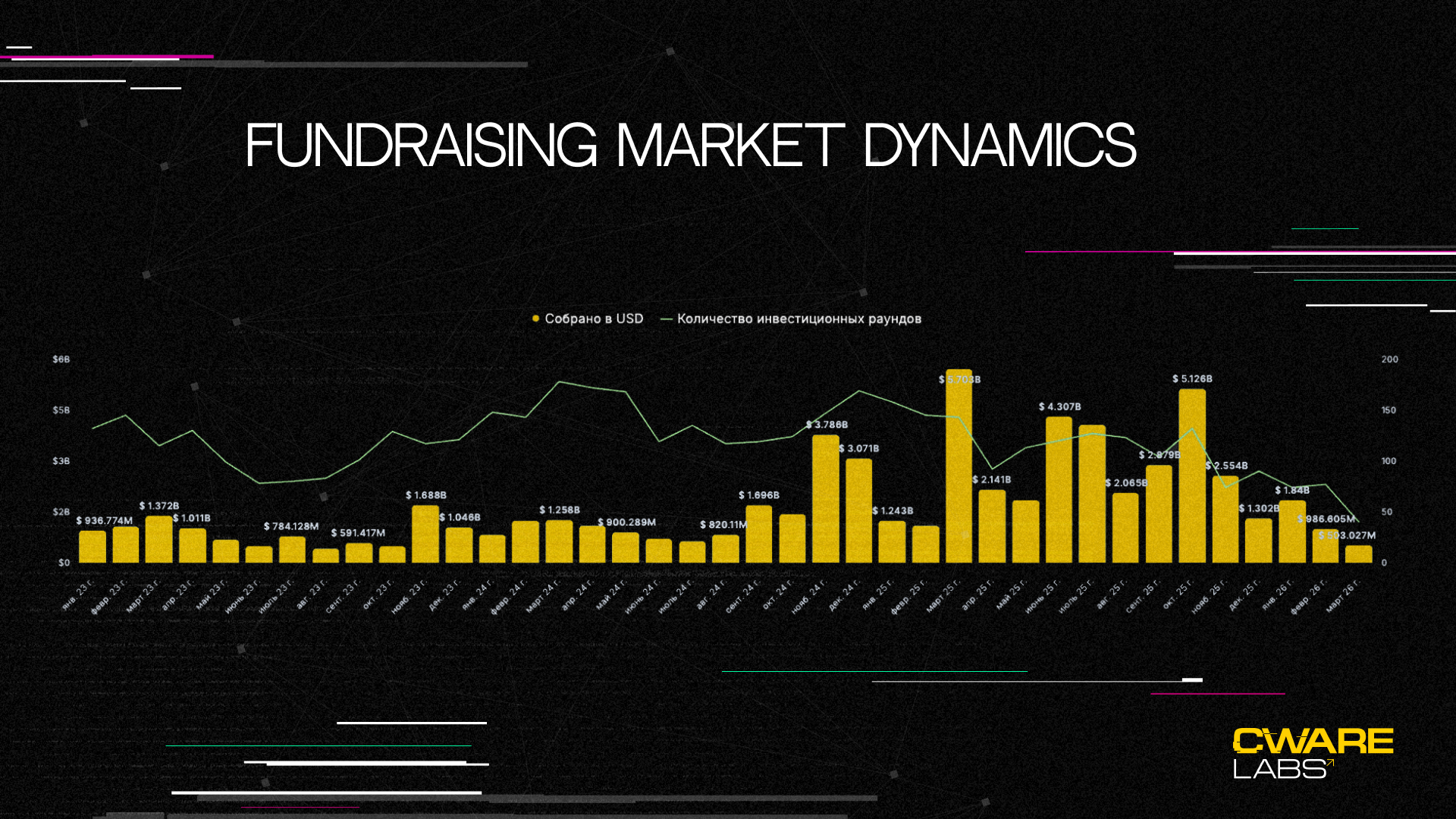
One of the most persistent myths in the Web3 community is that now is not the right time to raise a round. This myth survives every market cycle: in a bullrun, people say everything is already overvalued, in a bear market, they say investors have closed their doors.
Reality looks different. If you look at venture investment volumes in Web3 over the past 3 years, they have been at peak levels since 2022. There is capital in the market, and plenty of it. But it has changed.
Before, you could raise a round on an idea, a beautiful landing page, and the right narrative. Now investors are looking at completely different things: product, metrics, economics, team, timing. This is what is called smart money, capital that does not rush and knows how to choose.
Key market shift: before they invested in ideas. Now they invest in businesses. This means the requirements for projects have grown dramatically. And it is not the smartest teams that win, it is the most prepared ones.
How an Investor Actually Thinks
Before talking about founder mistakes, we need to address a fundamental question: what is actually going on in an investor's mind when they look at a project. Most founders approach investors with the mindset of "I have a great idea, look how interesting this is." The investor does not care. At all.
An investor is not a patron or a technology enthusiast. This is a person who manages other people's capital and is accountable for returning it with a multiplier. Their only question sounds like this: How likely am I to make a profit here?
Everything else is derived from that question. A team matters to an investor not because it is talented, but because a strong team reduces the risk of capital loss. The market matters not as a concept, but as proof that demand exists. Tokenomics matters not as a mechanism, but as a guarantee that the investor has a liquid exit.
The Five-Minute Filter
An investor makes their initial decision in 5 minutes. That is exactly how long you have to pass the primary screening. If you do not pass, your emails go unanswered, your deck goes unread, and you do not get a second look.
At this stage, 3 things are evaluated:
- Team - is there a reason to trust these people with capital?
- Narrative - does the project land within the current flow of investment attention?
- Timing - is this the right moment for this product in this market?
And here it is important to understand something non-obvious: you are not competing with other startups. You are competing for the attention of capital. An investor is not choosing the best project from the ones submitted, but the best allocation from all available options. This fundamentally changes the logic of a pitch.
The Narrative Market: Why the Best Products Don't Always Win
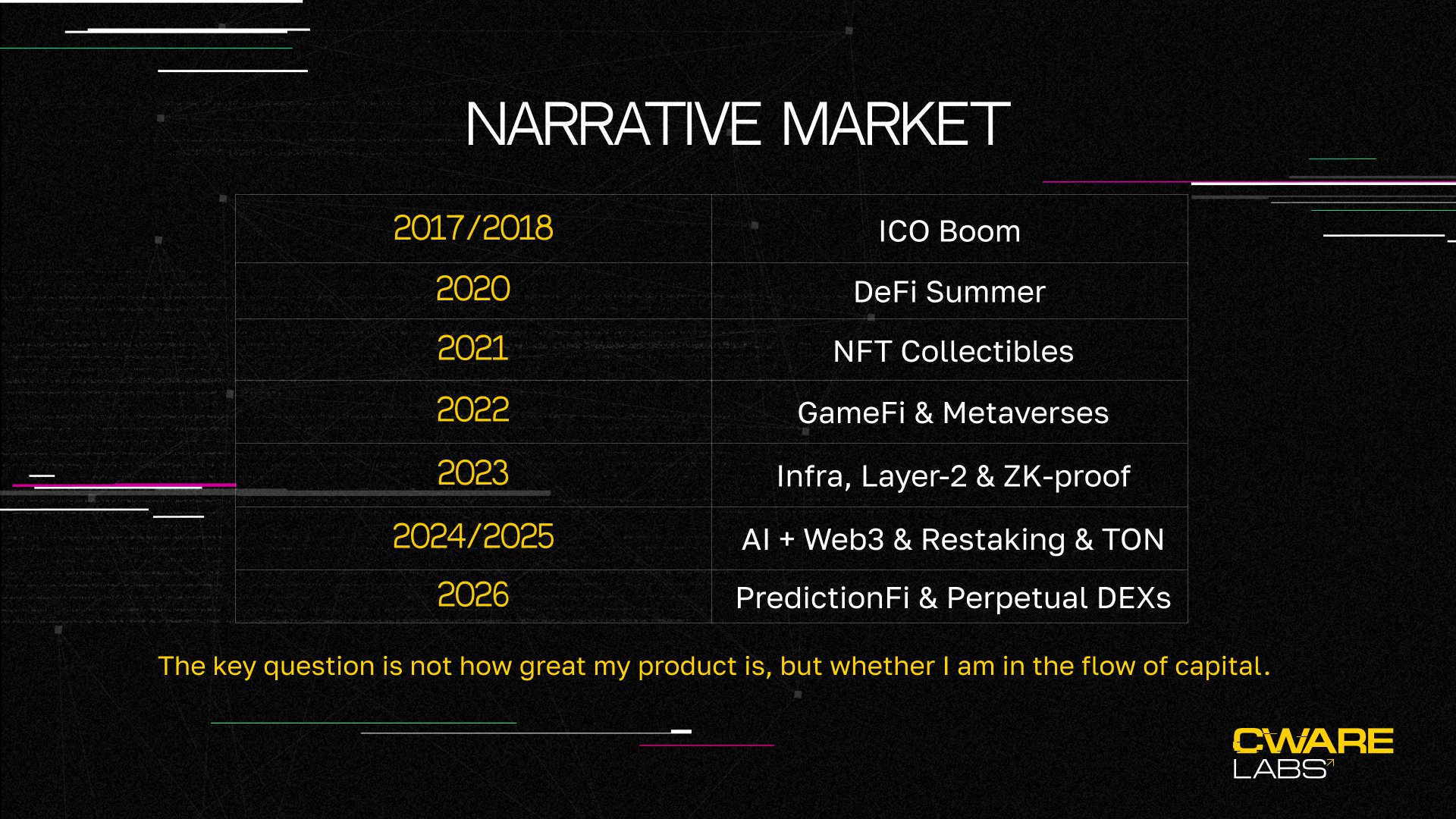
Web3 is a market where narrative often matters more than technology. This is an uncomfortable truth, but it needs to be accepted as fact and worked with accordingly.
Venture capital moves in waves. It concentrates on trends that set the pace for the entire market. In one cycle, it is DeFi, in the next, it is NFT and GameFi, then L2, RWA, and AI agents. In 2026, the priority areas for investors include Prediction Markets and Perpetual DEX.
At Cware Labs, we have seen situations where a technically weak project closed a round simply because it landed in the right narrative. And we have seen the opposite, strong teams with good products that could not raise money because they were going against the current flow of attention. This is not always fair, but this is the reality of the market.
What This Means for a Founder
The main question when building an investment strategy is not how good my product is, but whether I am in the flow of capital. If not, this is not a death sentence, but it is a serious complication. You need to be significantly stronger across every other parameter. Honest assessment: most projects are not ready for that standard.
Working with narrative correctly does not mean chasing hype. It means finding the intersection between what you are building and where the market is looking right now. Sometimes it is enough to reframe your positioning. Sometimes it means adjusting your roadmap. The key is to do it deliberately, not by accident.
4 Systemic Mistakes of Web3 Founders
Over years of working with more than 85 projects, we have identified four mistakes that appear with remarkable consistency. They do not depend on the stage, niche, or geography of the project. They are systemic.
1. Mistake One: The Investor Does Not Understand What You Do
This sounds obvious, but it is precisely this mistake that kills most pitches before the conversation even begins. If an investor cannot understand in 60 seconds what your product does, who it is for, why it matters, and how to make money from it, they will not spend the next 20 minutes reading your documentation. They will simply move to the next project in the pipeline.
The problem is not the investor. The problem is that founders are too deep inside their own product. They explain it in the language of technology, not the language of value. They use terms that require context. They assume the investor is already familiar with the problem.
Simple test: if you cannot explain your project in 30 seconds in plain language, your problem is not the investors. It is your packaging.
2. Mistake Two: No Traction, Metrics, or Validated Demand
The modern investment market requires proof. Good intentions and pretty forecasts are no longer enough. Traction is not necessarily revenue. It is any measurable signal that the market wants your product:
- Active MVP users.
- Community growth with genuine engagement.
- Partnerships and integrations.
- Results from paid channel testing.
The absence of this data does not mean the project is bad. But it means the investor is taking on maximum risk with minimal grounds for trust. Most funds will not do that.
3. Mistake Three: The Founder Is Selling an Idea, Not an Investment Case
This is an extension of the first mistake, but at a deeper level. The founder arrives with a pitch deck covering the technology, roadmap, team, and vision. All of that matters. But if there is no answer to the question, how much I will make and under what scenario, the conversation will not start.
The investor wants to understand what the entry valuation is, what the potential exit is, what needs to happen for the multiplier to work, and what risks could get in the way. This does not mean guaranteeing returns. It means speaking the investor's language, the language of probabilities, risks, and return on capital.
4. Mistake Four: Fundraising as a One-Time Action, Not a Process
The most costly mistake of all. Many founders think of fundraising like this: put together a deck, message investors, wait for a response, get the money. If no one responds, it's bad luck or the wrong market.
In reality, fundraising is a funnel. Systematic, measurable, requiring constant work. And like any sales funnel, it has specific conversion rates: 200 contacts → 10-15 calls → 1-2 investors.
This is a normal conversion rate for the Web3 market. If you messaged 10 investors and heard nothing back, you did not get rejected. You simply have not started the process.
Web3 Startup Stages and Their Connection to Fundraising
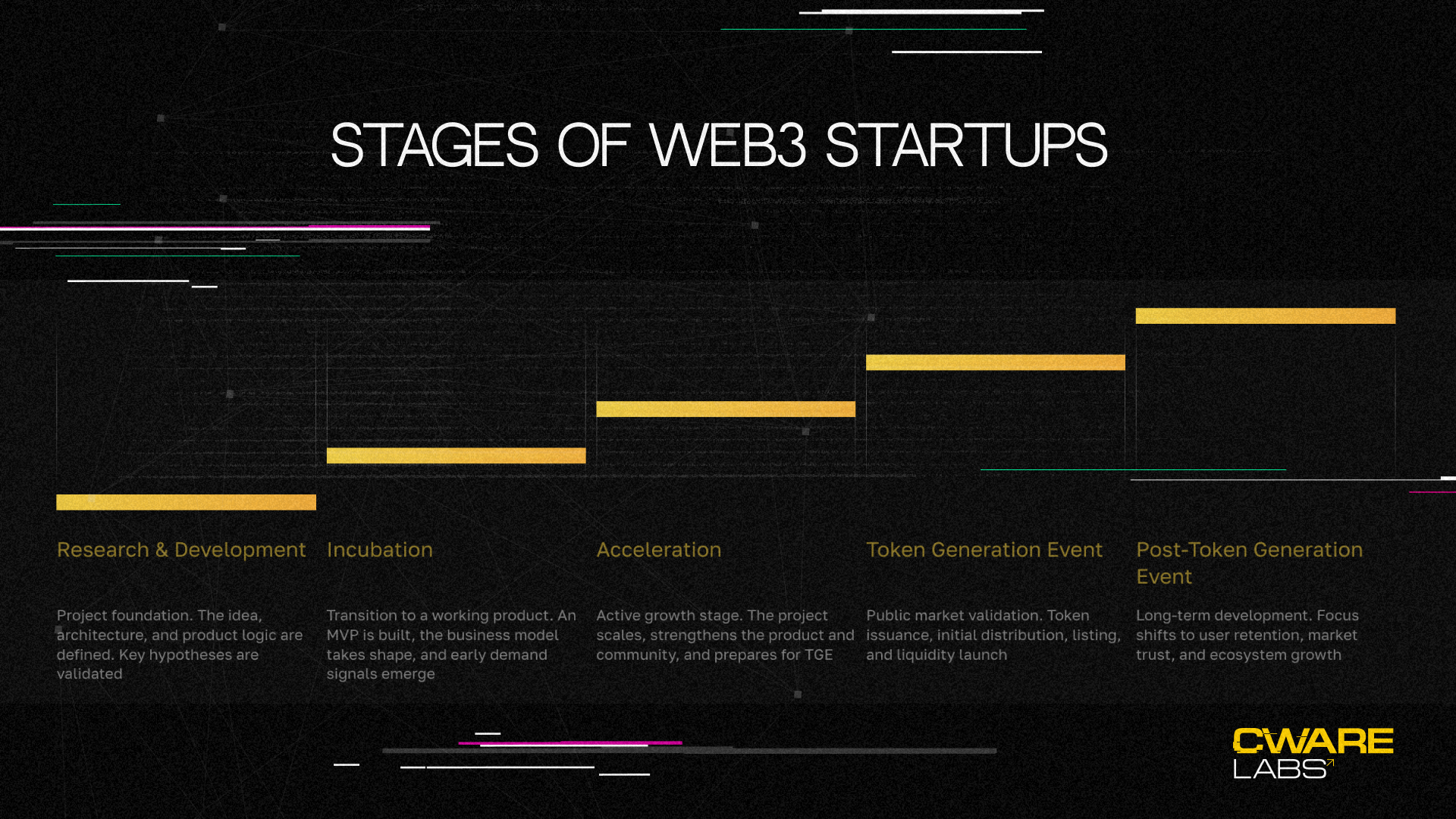
One of the core reasons fundraising fails is a mismatch between the project's stage and its fundraising strategy. Each stage has its own rules, its own investors, and its own requirements.
1. Stage 1: R&D - Idea and Foundation
At this stage, you have a hypothesis, possibly a team, and early sketches of a product. No formal metrics, no MVP, no market validation.
Who invests at this stage: Friends, Family, Fools, the so-called 3F round, Angels, and, in rare cases, very early Pre-Seed funds if the founder has a reputation or traction from previous projects.
The mistake most make: going directly to venture funds at this stage. The outcome is predictable: silence or a polite pass.
2. Stage 2: Incubation - MVP and First Traction
Here, a working product appears, along with the first users and initial usage metrics. This is the moment when a careful and targeted approach to investors can begin.
The keyword is careful. A Seed round requires not scale, but reproducibility. The investor wants to see that the project knows how to attract and retain users, even in small volumes.
3. Stage 3: Acceleration - Product, Growth, Institutional Interest
Here, the serious conversation starts. The product is stable, metrics show momentum, the community is growing, and tokenomics is developed. This is the stage of Private and Strategic rounds, where larger funds enter the picture. At this stage, the investor is not buying potential, but validated growth logic.
4. TGE and Post-TGE Stages
This is a separate story, where the project faces its real market test. TGE is not the finish line; it is the beginning of a new phase of accountability to token holders, partners, and the ecosystem.
The main takeaway on stages: your fundraising strategy must match your stage. Trying to skip a stage almost always ends in failure or a toxic cap table that blocks future rounds.
Investment Packaging: What It Is and Why It Gets Overlooked
One of the most common misconceptions in the Web3 community: investment packaging is a pitch deck. In reality, the deck is just one element of the system. Investment packaging is the entire body of materials and structures through which an investor builds their understanding of your project. It needs to work without your presence, without explanations, and without context.
6 Blocks Every Fund Checks
- Concept. Clear positioning, a defined value proposition, and a developed narrative. The investor needs to understand what you do in 60 seconds.
- Business model. How the project makes money, where revenue comes from, and what the unit economics look like. A missing or vague business model is a red flag for any fund.
- Tokenomics. Not just token distribution, but the logic of the economic system. How the token connects to product growth, how vesting is structured, and what mechanics keep holders engaged.
- Go-to-market strategy. How you acquire users, through which channels, with what budget, and against which success metrics. The absence of a GTM strategy signals that the team does not understand the market.
- Product documentation. Whitepaper, technical documentation, smart contract audits, roadmap. This is not marketing, it is evidence.
- Investment documentation. Term sheet, cap table, legal structure, SAFT or other investment instrument.
If even one of these blocks is weak or missing, you get cut at the primary screening. Not with a rejection, but with silence, which is considerably worse.
Dataroom as the Central Point of Packaging
All documentation should be organized in a single space, a dataroom. This can be Notion, Google Drive, or a dedicated tool. The core requirement: an investor should be able to find any piece of information in 2 minutes without having to call you.
Most projects do not have a proper data room. They send individual files on request, lose track of versions, and fail to sync data. This creates the impression of operational immaturity, even if the product itself is excellent.
How Funds Actually Evaluate Projects: Primary Scoring
Funds do not study every project in depth. They do not have the capacity for that. When we worked with a small investment fund, more than 350 projects entered the pipeline every month. Imagine the volume that Paradigm, The Spartan Group, or a16z crypto receives.
A team of analysts cannot physically run full due diligence on every project. That is why primary scoring exists, a quick evaluation against a set of criteria that takes from 3 to 10 minutes. Today, this process is increasingly automated through AI tools.
Based on scoring results, projects are divided into 3 groups:
- Move forward - meet stage requirements, clearly explained, and have traction.
- On hold - interesting but needs work. May return later.
- Cut - did not pass the initial filter. Often without any explanation.
Most projects end up in the third group. Not because they are bad, but because they are not ready for scoring.
Cware Labs Scoring System
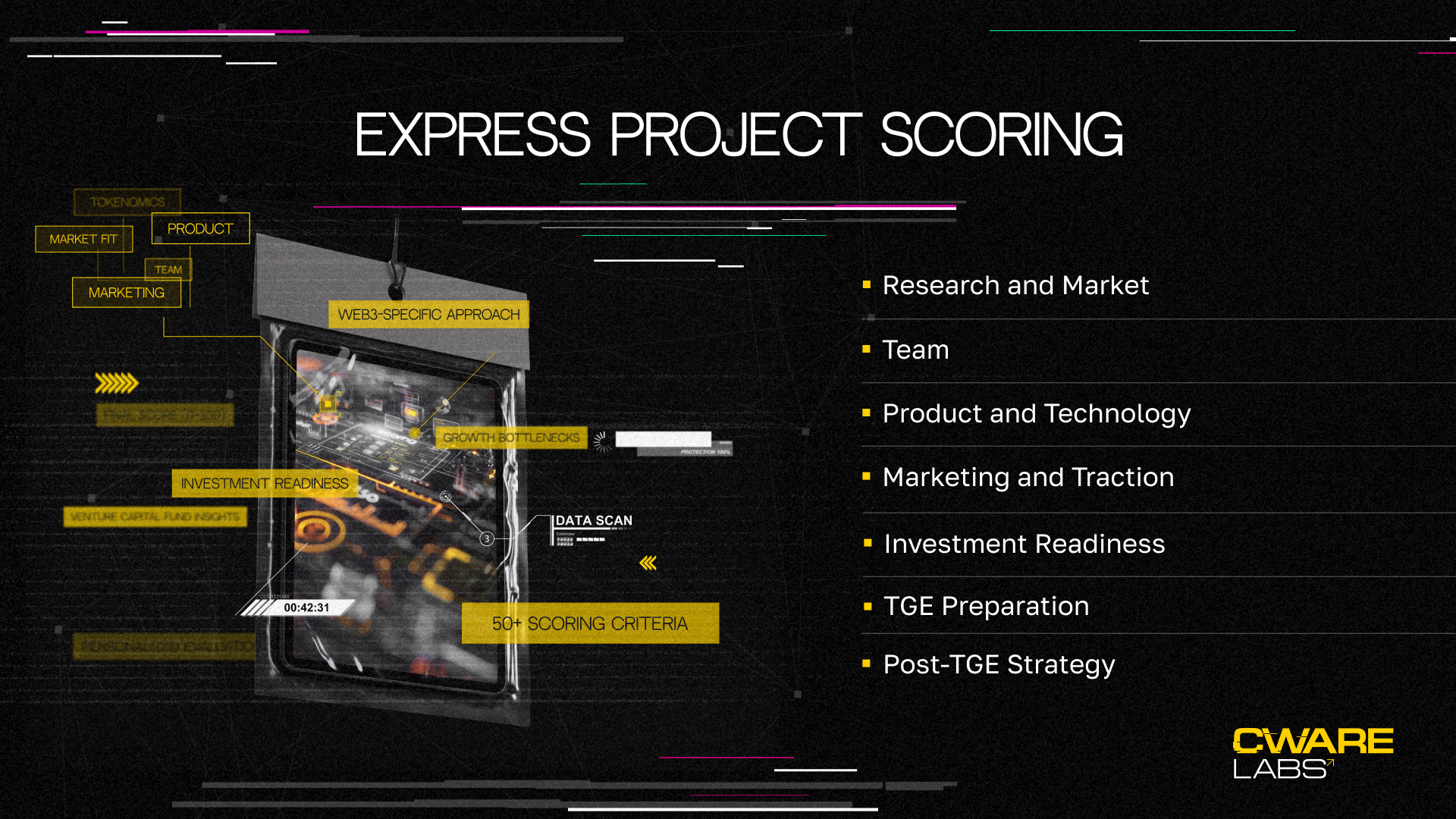
That is exactly why we at Cware Labs built our own scoring model. It covers 7 key blocks and more than 50 parameters, a simulation of how a venture investor sees your project during initial screening.
The scoring does not answer how good my project is. It answers what specifically needs to improve to successfully pass an investment round. That is a fundamental distinction. An assessment without recommendations is just a number. Scoring with analysis is a roadmap to investment readiness.
Fundraising as a System: How It Works in Practice
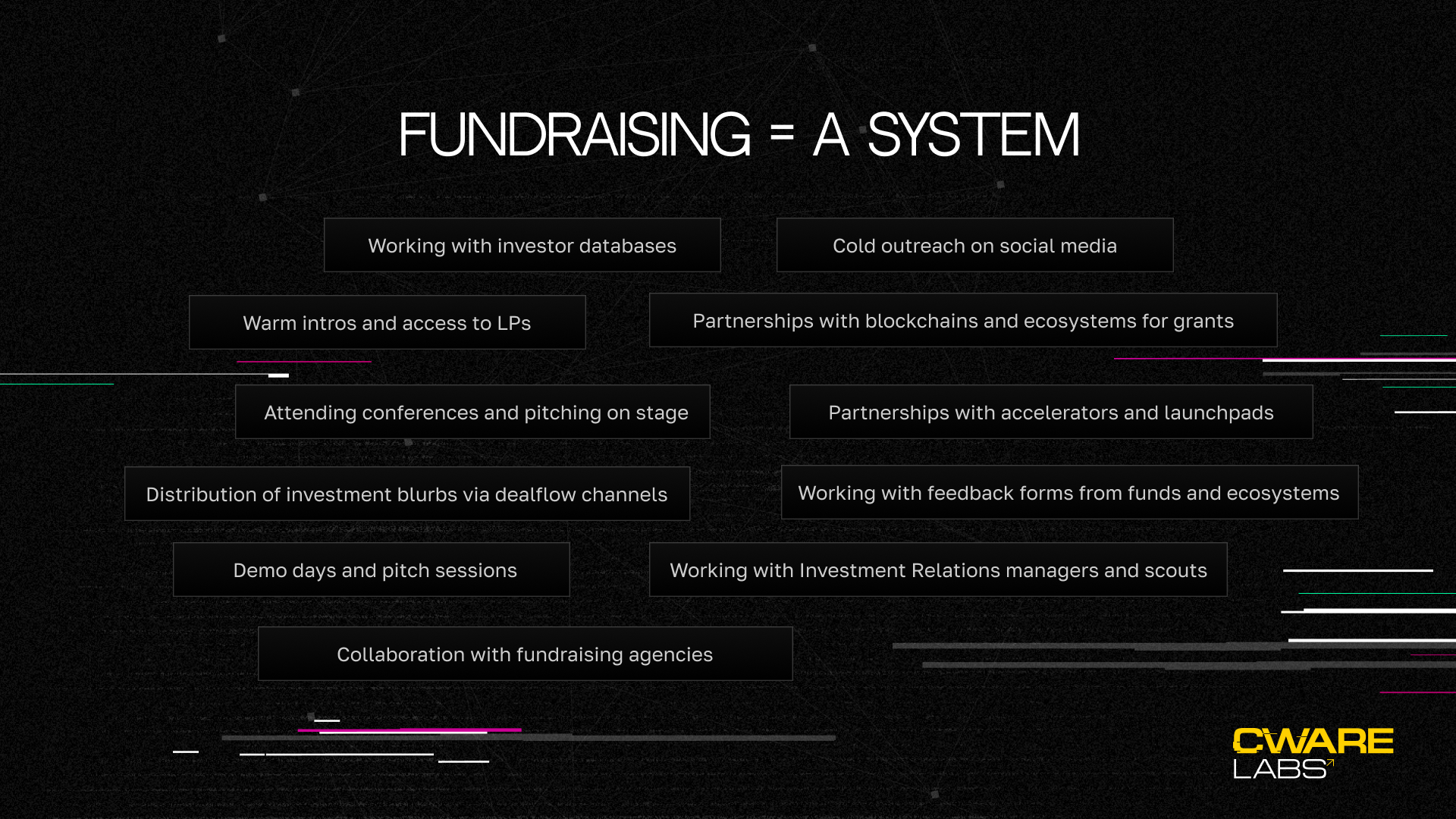
Now to the most important point. Everything we discussed above only makes sense as part of a unified system. Raising investment in Web3 and AI is not an event. It is a process that includes several parallel workstreams running simultaneously.
3 Pillars of Systematic Fundraising
- Understanding the market and investor logic. Without this, any outreach turns into random shooting. You need to know who your target investor is, what they are looking for right now, what their investment thesis is, and how you fit into it.
- Strong investment packaging. Dataroom, pitch deck, one-pager, tokenomics doc, financial model, all of this needs to work in sync with no weak links. Not a single element can be the breaking point.
- Strategy and operational discipline. Fundraising is daily work: outreach, follow-ups, repeated touchpoints, working warm leads, attending events, PR, and publications. This is not something you do once a month. It is something you do every day.
The Fundraising Funnel: Numbers That Matter
A typical funnel for a Web3 and AI project looks like this:
- 200 contacts with investors (cold and warm outreach).
- 10-15 calls (initial dialogue, pitch).
- 2-3 projects in DD (due diligence).
- 1 investor (closed deal).
This is a good conversion rate. But many founders treat 10 outreach messages as tried fundraising. That is not even the beginning of the funnel. A round almost never closes through 100 contacts. It closes through a system: packaging → outreach → calls → follow-ups → repeated touchpoints → deal.
The Real Cost of Fundraising
Another myth: you can find a person or agency that will raise investment for a 5% success fee. The market does not work that way.
Fundraising is a full operational process with real costs. At Cware Labs, operational expenses per project start at $2,500 per month. And that is the minimum threshold for systematic work.
If you are not willing to invest in fundraising, you will not raise investment. That is not an opinion. It is math.
Why Good Projects Do Not Get Funded
The hardest truth for last. Most projects do not get rejected. They get simply ignored. The investor did not understand what you do. They did not see an investment case. Did they not find an answer to the question – how much will I make – in your materials? And instead of spending 20 minutes on a project that did not explain itself in 60 seconds, they simply opened the next email.
This is not cruelty. This is the rational behavior of a person who receives dozens of pitches every day. And that is exactly why the paradox exists: good projects get cut not because they are weak, but because they are poorly explained. Packaging is not cosmetic. It is the system that lets your project speak to the market without you in the room.
Conclusion: It's Not the Smartest Who Win, It's the Most Prepared
The money is in the Web3 market. Investors are active. Venture funds are looking for projects. But the standards have risen dramatically, and those who have not adapted to the new rules of the game will keep receiving silence in response to their pitches.
To summarize everything we covered:
- Investors buy the probability of a return, not the beauty of an idea.
- Narrative and timing matter just as much as the product.
- Fundraising is a funnel, not a broadcast.
- Investment packaging is a system, not a pitch deck.
- Every stage has its own rules and its own investors.
- A prepared project always beats an unprepared one.
At Cware Labs, we work exactly on this, helping Web3 and AI projects go from a good idea to an investment-ready business. Over the past 6 years, we have worked with 85 clients, participated in raising more than $25 million, and seen more than 50 new projects every month.
This gives us one key asset: we see the market from the inside. And that is the knowledge we bring to every project we work on.
Ready to Raise Your Investment Round?
If you are currently building a Web3 project or planning to go out for an investment round, we invite you to a free express scoring session.
You will receive an evaluation across 50+ parameters, a PDF report, and practical recommendations on your next steps. The strongest projects from scoring results are published in our closed dealflow hub, with access to more than 150 representatives of venture funds.
Fill out the short form on our website: https://cwarelabs.com/form
